Daniel Kahneman and Your Money: What a Psychologist Taught Us About Investing
Kahneman never worked in finance, yet his research explains more about investor behaviour than most economics textbooks. Here's what every saver should take from his life's work.
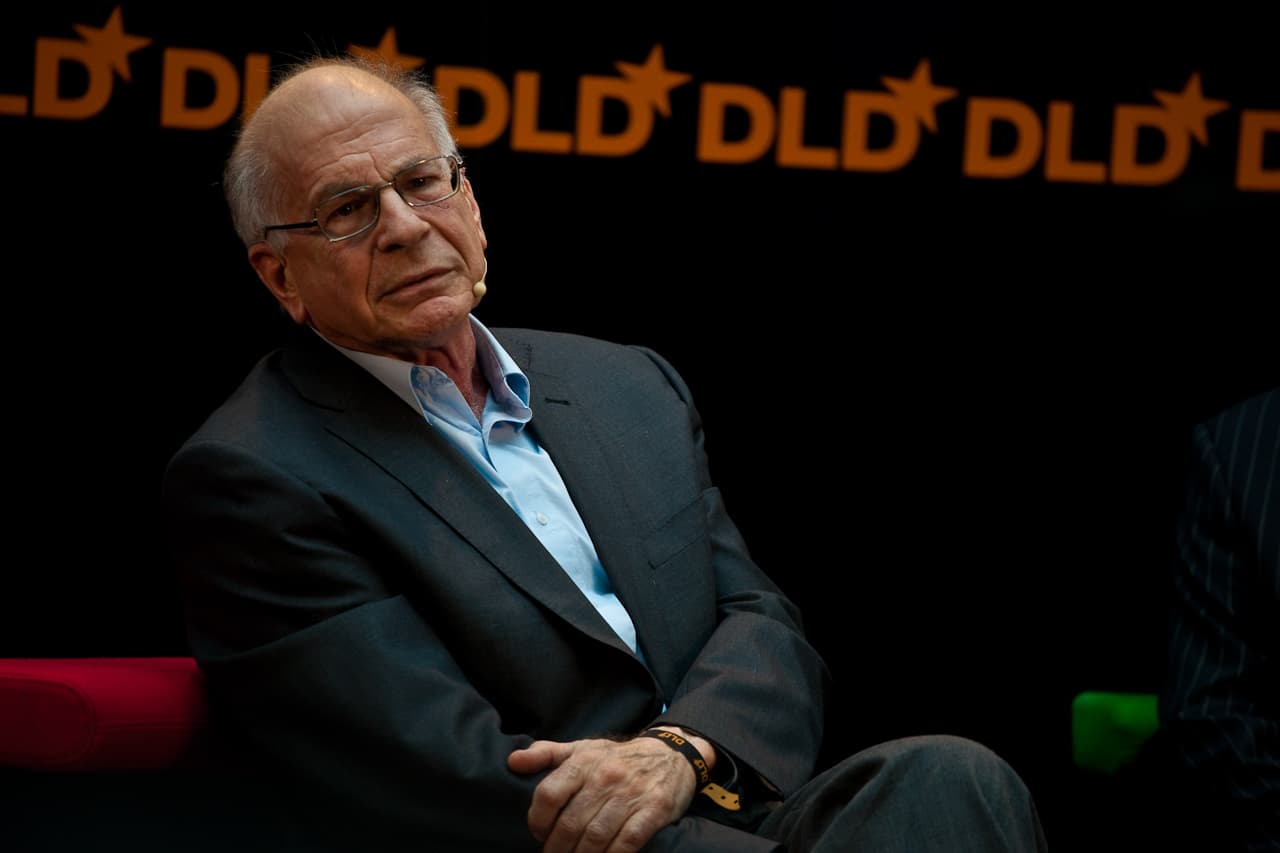
The Psychologist Who Won the Nobel Prize in Economics
Daniel Kahneman, who died in March 2024 at the age of 90, never took an economics class. He was a psychologist — trained in perception and attention, shaped by a childhood spent hiding from the Nazis in occupied France, and sharpened by decades of work with his collaborator Amos Tversky.
And yet, in 2002, he won the Nobel Prize in Economics. His work, quietly and without fanfare, dismantled one of the core assumptions underpinning modern finance: that human beings are rational calculators of risk and reward.
If you've ever sold an investment in a panic, held onto a losing fund because selling would "make it real", or felt certain the market was about to crash — only to watch it climb — you've lived inside Kahneman's research. His insights aren't academic curiosities. They are the single most useful body of knowledge a retail investor can learn, and they explain more about why portfolios underperform than any spreadsheet ever will.
The Central Idea: We Are Not Rational
Classical economics assumed a creature called homo economicus — a person who weighs probabilities carefully, updates beliefs based on new evidence, and pursues their long-term interest with cold efficiency. Kahneman and Tversky showed, through hundreds of elegant experiments, that this creature does not exist.
Instead, they found that human decision-making is shaped by mental shortcuts — heuristics — that worked well enough for our ancestors navigating a dangerous savanna, but serve us terribly in a world of index funds, inflation data, and 40-year retirement horizons.
We don't calculate. We feel. And the feelings are systematic, predictable, and — once you know to look for them — visible everywhere in financial markets.
Prospect Theory: Why Losses Hurt More Than Gains Feel Good
The paper that eventually earned Kahneman the Nobel Prize, co-authored with Tversky in 1979, is called "Prospect Theory: An Analysis of Decision under Risk". It is one of the most cited papers in economics, and its central finding is deceptively simple.
Imagine I offer you a coin flip. Heads, you win £150. Tails, you lose £100. The expected value is clearly positive — any rational person should take this bet. Most people refuse.
Now reverse it. You're facing a certain loss of £100, but I offer you a 50/50 chance to lose £200 or lose nothing. The expected value of the gamble is worse than simply accepting the £100 loss. But most people take the gamble.
From these kinds of experiments, Kahneman and Tversky extracted two profound observations:
- Loss aversion. Losses are felt roughly twice as strongly as equivalent gains. The pain of losing £100 is about as intense as the joy of winning £200.
- Risk-seeking in losses. When facing losses, we become gamblers. We'd rather roll the dice on a bigger loss than accept a smaller, certain one.
These two findings explain an enormous amount of investor behaviour:
- Why people refuse to sell losing funds even when better opportunities exist (selling would "realise" the pain).
- Why a 20% market drop feels catastrophic while a 20% rise feels merely pleasant.
- Why investors check their portfolio daily in good times and avoid it entirely in bad ones.
- Why "just waiting to get back to breakeven" is one of the most common and destructive investing mistakes.
Every decision to hold a dying stock, every panicked sell at the bottom, every refusal to rebalance — prospect theory predicted it, decades before retail trading apps existed.
System 1 and System 2
In his 2011 book Thinking, Fast and Slow, Kahneman introduced a metaphor that has entered the cultural bloodstream: the idea that the mind operates in two modes.
System 1 is fast, automatic, intuitive, and emotional. It recognises faces, reads tone of voice, and reacts to threats before you can articulate what's happening. It's the mode you're in for most of the day.
System 2 is slow, deliberate, effortful, and analytical. It does long division, compares mortgage rates, and reads the small print on a pension statement. It takes energy, and the brain avoids using it whenever System 1 can get away with a quick answer.
The problem for investors is that financial decisions feel like System 1 territory — they feel urgent, emotional, high-stakes — but they actually require System 2. When markets crash, your gut screams "get out". That's System 1, running an ancient predator-avoidance script. The correct response — do nothing, or better still, buy more — requires System 2 to override the panic. And System 2 is tired, distracted, and slower to the draw.
This is why the best portfolios are the ones you look at least. Every glance at your balance is an invitation for System 1 to take the wheel, and System 1 will almost always make a worse decision than the plan you built on a calm Sunday afternoon.
Anchoring
Another of Kahneman's findings was the astonishing power of arbitrary numbers to shape our judgment. In one famous experiment, participants were asked to spin a wheel of fortune that landed on either 10 or 65. They were then asked what percentage of UN countries were African. People who had spun 10 guessed around 25%. People who had spun 65 guessed around 45%.
The wheel number was obviously random. It had nothing to do with Africa. And yet it shifted the answer dramatically. This is anchoring — the tendency to latch onto a nearby number when uncertain.
Anchoring haunts investing. The price you paid for a stock becomes the number you "need to get back to" before selling — even though the market doesn't know or care what you paid. The all-time high becomes the benchmark against which every subsequent price feels like a loss. The £1 million retirement target, which you pulled from a magazine article years ago, becomes the number you chase long after your actual needs have changed.
Kahneman's advice was not to eliminate anchoring — you can't — but to recognise when a number you're reacting to has no logical basis. The price you paid is irrelevant to whether a fund is a good investment today. What matters is the forward expected return, the fees, and the fit with your goals. Anchoring pretends otherwise, and it costs investors enormously.
The Narrative Fallacy and the Illusion of Understanding
Kahneman was scathing about the human tendency to construct neat stories from noisy data. Markets fall, and commentators explain it the next morning as if the cause was obvious — "investors worried about inflation", "concerns over China" — when in reality nobody knows why thousands of independent decisions aggregated into a particular number on a particular day.
He called this the illusion of understanding. We mistake our ability to explain the past for an ability to predict the future. Pundits who confidently predicted three of the last zero recessions still get invited back on television. Fund managers with five years of strong returns are treated as geniuses, even though the maths of random chance predicts exactly this pattern of apparent outperformance.
The practical lesson is brutal: if you're making investment decisions based on narratives — the commentator's story, the headline's framing, the analyst's target — you're making decisions based on noise dressed up as signal. Kahneman's research suggests that most "expert" forecasts in finance are no better than chance, and often worse, because confidence scales faster than accuracy.
The Peak-End Rule and Your Financial Memory
One of Kahneman's quieter findings has surprising implications for how you feel about your portfolio. He showed that our memory of an experience is dominated by two moments — the emotional peak and the end — rather than the average of the whole experience.
This matters because you will remember your investing life not as a continuous average but as a handful of vivid moments. The crash of 2020. The runup to an all-time high. The day you sold too early. The week you wish you'd bought more.
If you check your portfolio during a crash, that becomes a peak moment embedded in your memory. Years later, you'll "remember" that investing felt terrifying, even though the objective reality was that your portfolio recovered within months and went on to new highs. The peak-end rule quietly rewrites your financial history in ways that make future mistakes more likely.
The defence is structural: reduce the number of peak moments by reducing the number of times you look. You cannot build a traumatic memory of a crash you didn't watch happen in real time.
What Kahneman Thought About His Own Biases
Perhaps the most disarming thing about Kahneman is that he was entirely clear-eyed about one uncomfortable truth: knowing about cognitive biases does almost nothing to protect you from them.
In interviews toward the end of his life, he admitted that after more than 50 years of studying these effects, he was still just as susceptible to them as everyone else. He still felt loss aversion. He still anchored. He still constructed narratives from noise. The biases are not bugs that can be patched by awareness. They are features of how the human mind works.
This has a profound implication for personal finance. The solution is never "learn the biases and then think harder". The solution is to build systems that protect you from yourself — automatic contributions, fixed asset allocations, long rebalancing intervals, and the discipline to ignore short-term noise. You cannot out-think your own psychology. You can only design around it.
The Practical Checklist
If you take nothing else from Kahneman's work, take this. Every one of these practices is a direct response to a specific cognitive failure mode he documented:
- Automate everything. Standing orders into your ISA or SIPP defeat loss aversion because the decision is already made.
- Write down your plan when calm. A written investment policy, drafted on a quiet Sunday, is your System 2 protecting you from your future System 1.
- Check your portfolio rarely. Quarterly is plenty. Monthly is a lot. Daily is self-harm.
- Ignore the story. The narrative explaining today's market move was written in the last 20 minutes and will contradict tomorrow's.
- Pre-commit to action. Decide in advance what you'll do if markets fall 20%, 30%, 40%. "Keep buying" written down is worth a hundred good intentions.
- Rebalance mechanically, not emotionally. A fixed rule ("every January") removes the decision from the hands of whichever mood you happen to be in.
- Respect the price you paid as irrelevant. What you paid is sunk. What matters is what the investment is worth today and what it's likely to be worth tomorrow.
Every one of these is boring. None of them feel like investing. That's the point. The best investment behaviour, according to the most important psychologist of the modern era, looks suspiciously like doing nothing, on purpose, most of the time.
A Quiet Legacy
Kahneman did not set out to fix investing. He set out to understand the mind. But in doing so, he mapped the precise territory on which investors routinely destroy their own returns — and in mapping it, he gave ordinary people a fighting chance against their own instincts.
The people who will benefit most from his work are not the academics who cite him, or the fund managers who claim to have "incorporated behavioural finance" into their process. They are the savers who quietly set up a monthly direct debit, pick a sensible diversified fund, and then go and live their lives without watching the screen. They will outperform most of the professionals, and they will do it by following a playbook written by a psychologist who never bought a stock based on a forecast in his life.
That is Kahneman's real legacy for your money. Not a trading strategy. Not a model. A deep, humbling, and slightly unflattering understanding of the enemy in the mirror — and the simple, boring, effective habits that keep that enemy at bay.
Model It, Don't Feel It
If you want to see how the behavioural mistakes Kahneman described would play out in your own retirement plan — panic selling, market timing, over-reacting to a crash in year one — you can run a simulation. Our Monte Carlo model can show you the difference between the investor who stays the course and the one who doesn't. Often, the gap is worth more than any contribution you'll ever make.
Further Reading
- Kahneman, D. (2011). Thinking, Fast and Slow. Farrar, Straus and Giroux.
- Kahneman, D. & Tversky, A. (1979). "Prospect Theory: An Analysis of Decision under Risk." Econometrica, 47(2), 263-291.
- Tversky, A. & Kahneman, D. (1974). "Judgment under Uncertainty: Heuristics and Biases." Science, 185(4157), 1124-1131.
- Kahneman, D., Sibony, O. & Sunstein, C. R. (2021). Noise: A Flaw in Human Judgment. William Collins.
- Lewis, M. (2016). The Undoing Project: A Friendship That Changed Our Minds. W. W. Norton.
Run 1,000 Monte Carlo simulations across your pensions, ISAs, and investments — completely free.
Get Started Free
